
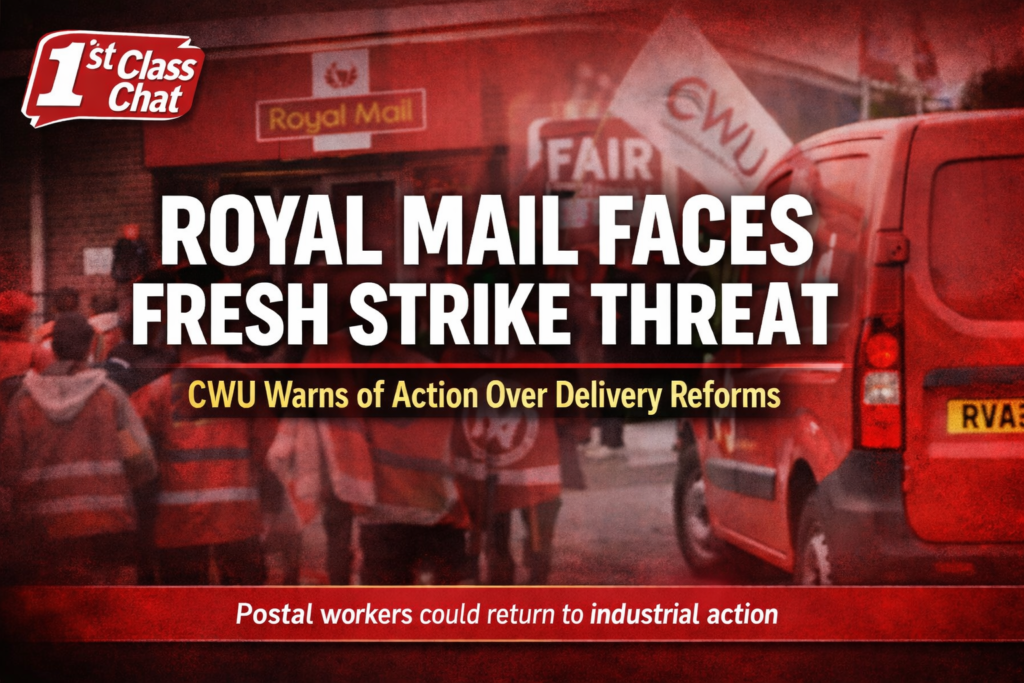
Royal Mail is facing the growing prospect of renewed industrial action as tensions with the Communication Workers Union (CWU) escalate over the company’s plans to overhaul letter delivery services across the UK.
The long-running dispute, which has now stretched beyond 18 months, centres on proposed reforms to the postal service, including controversial plans to remove Saturday deliveries for second-class letters. While the CWU, which represents more than 100,000 postal workers, has stated that it is not opposed to modernisation in principle, it has repeatedly raised concerns over how Royal Mail intends to introduce the changes.
Union officials argue that trial schemes launched around a year ago have failed to deliver the promised benefits and have instead created operational problems on the ground. The CWU has accused Royal Mail management of refusing to acknowledge these issues, claiming senior figures are “in denial” about the real-world impact on staff and services.
Royal Mail has now formally triggered its dispute resolution process with the CWU, a move that initiates a one-month period aimed at reaching an agreement. However, the company has made clear that if no deal is secured within that timeframe, it intends to press ahead with the reforms regardless.
That stance has prompted a sharp response from the CWU, which has warned it will not endorse the proposals in their current form. The union has also indicated that both localised and national industrial action could be on the table should Royal Mail attempt to impose the changes without agreement.
The warning marks the strongest signal yet that postal workers could once again take strike action, following the highly disruptive disputes of 2022. Those strikes lasted more than a year and reportedly cost Royal Mail around £1 million per day, leaving lasting scars on industrial relations.
At the heart of the disagreement is Royal Mail’s Universal Service Obligation, which commits the company to delivering mail six days a week to every address in the UK. Royal Mail argues that this model is no longer financially viable due to a steep and sustained fall in letter volumes, and that reform is essential to secure the company’s future.
The dispute has also taken on a political and ownership dimension. In November, the CWU publicly criticised Daniel Křetínský and his EP Group, which acquired Royal Mail for £3.6 billion last year, accusing the new owners of failing to honour commitments made during the takeover process.
Royal Mail maintains that it remains open to reaching an agreement but has signalled its intention to begin rolling out the reforms in the spring. A company spokesperson said that reforming the Universal Service is critical to protecting Royal Mail’s long-term financial stability, warning that further delays could put the business at risk.
As the deadline approaches, the coming weeks may prove decisive in determining whether talks prevail — or whether postal workers once again find themselves on the picket line.